Please VISIT OUR WEBSITE

To order images, prints, or cards, click here

Tuesday, November 19, 2013

Hiking Kanarra Creek Canyon to Kanarra Falls


Hiking Kanarra Creek Canyon to Kanarra Falls near Zion National Park is awesome. The red sandstone canyon is gorgeous. The creek runs year-round. Two 10 to 15-foot waterfalls provide a fun challenge to the hiker and are beautiful photo ops.
Kanarra Falls in Kanarra Creek Canyon with ladder and ropes as of November 2013

Entering a slot canyon for the first time takes your breath away. The rich striking colors, dramatic textures, and marvelous light bouncing and reflecting off towering stone walls of the slot canyons of Utah and Arizona are stunning, fascinating and compelling. They can be mesmerizing to a photographer.
Kanarra Creek Slot Canyon

While many slot canyons require some technical equipment and skill in climbing and canyoneering, the hike to Kanarra Falls, on BLM land near the little town of Kanarraville, Utah, is relatively easy by comparison and the canyon is both dramatic and extraordinarily photogenic. So when we saw an eye-catching photo of Kanarra Falls by David J. West and realized we were very close to this canyon, Randy said “let’s check it out,” and I jumped at the chance.

Formed by water erosion over millions of years, usually in sandstone or limestone, slot canyons are known for being extraordinarily narrow and deep. Sometimes they are barely more than a foot wide. They can be 300 feet deep. Their tall rock walls come in all the colors of sandstone from deep reds and oranges through pinks and even purple.

Reflected light makes the red sandstone almost luminous

This particular hike was about 3 miles round trip to the first waterfall, or one could extend the hike another mile round trip to the second waterfall. The hike starts out on a dirt road at the end of which the canyon narrows fairly quickly. From there the trail is not maintained. It consists of paths where people have scrambled up the banks of the creek, over boulders and fallen trees, through brush, and back and forth across the creek. 

Kanarra Creek below the slot canyon section

Winter was getting ready to close in when we hiked to the first waterfall in mid-November, wearing neoprene booties to insulate our feet - which nevertheless became numb from the cold after walking and standing in icy water for a couple of hours. We followed the path of Kanarra Creek, walking in the creek itself much of the time, and along the trails on both sides. I think there was a trail higher up on the hillside that would have been much drier, but we didn’t want to miss seeing any of the canyon or stream bed. 

Setting up for a photo in Kanarra Creek Canyon

A few hundred yards after entering the slot portion of the canyon, we could hear the sound of Kanarra Falls, and then rounded a couple of bends with the towering red sandstone walls above us, to see the waterfall. 

Hiking in the slot portion of Kanarra Creek Canyon

The log “ladder” that guides had warned “may or may not be present” was not only present, but much improved from photos we had seen - though it was not quite as photogenic as the more makeshift ladder of earlier years, with crooked wood pieces nailed onto the log. Who knows what the ladder will look like after another season and a few flash floods! We were too cold, and it was too late in the day, to climb the ladder and go on, so we did not see the second waterfall on this first trip.


A ladder at Kanarra Falls helps the hiker continue upstream

National Geographic’s AllTrails Journal names Kanarra Creek and Kanarra Falls one of the five best slot canyon hikes in southern Utah. One Zion National Park site rightly calls it the "perfect stop for the amateur looking for professional photo opportunities." Some commentators have called this hike a fun and easy family hike, great for kids. Several call it moderate. Canyoneering USA calls it "mild to moderate." The ClimbUtah.com website calls it a “semi-technical canyoneering adventure.” Photographer Joe Braun calls it “fairly strenuous.” 

If you try this hike, you should be in fairly good shape, and definitely expect to get wet. You cannot see the slot portion of the canyon or the waterfalls without walking in the creek. Read a few accounts of the hike online so you have an idea what to expect and what to wear. By all means check the weather and be aware of flash flood danger. Do not hike in the canyon if there is rain anywhere in the forecast!


A few good websites with more information and some great photos are:
Canyoneering USA: Kanarra Creek
Zion-National Park Kanarra Creek
Utah Trails: Kanarra Creek Canyon
National Geographic AllTrails Journal: Five Best Hikes in Slot Canyons - SW Utah

Sunday, March 24, 2013

Elephant Seals at Piedras Blancas, California


Northern elephant seals are impressive and fascinating marine mammals. A great place to observe and photograph elephant seals is at the elephant seal rookery at Piedras Blancas, on the California coast, at the southern end of Big Sur. We spent two days in late January at Piedras Blancas to shoot these images.

Male (center) and female (foreground) Elephant Seals vocalizing


Here the elephant seals come to shore between December and February to give birth, nurse their young, and mate. An estimated 17,000 animals come to the rookery at Piedras Blancas during these months, although they are not all there at the same time. During the rest of the year they spend at least eight months at sea, never coming to land.

Female Elephant Seals and their pups on the beach with one male in the background 


Male elephant seals are much larger than females, weighing up to two and one-half tons and measuring up to 16 feet long, while females grow to 1,800 pounds and about 12 feet long. The males have a huge proboscis, longer in the older animals, that gives this animal its name. 

Note the long proboscis on the male Elephant Seal, and the scarring on his chest from many fights


The males will vocalize and posture to begin to establish dominance over an area of the beach. Sometimes they go farther with serious fighting, bumping their bodies together and biting each other’s chests. 

Two male Elephant Seals fighting


We saw the water go red with blood when these two fought. The older males develop a distinctive chest “shield” of very tough, calloused skin with extensive scarring from their many battles over territory and females. 

We saw blood in the water during the fight between these two male  Elephant Seals


While at sea, elephant seals dive for 20-30 minutes at a time, feeding on rays, small sharks, crabs, shellfish, octopus and squid. Dives of over 5,700 feet and more than two hours have been recorded.

Piedras Blancas lies within the Monterey Bay National Marine Sanctuary, which extends  along 276 miles of the California coast from north of the Golden Gate bridge to Cambria in southern San Luis Obispo County. Piedras Blancas is at the southern end of this area, on scenic California Highway One, 12 miles north of Cambria.


Elephant Seals on the beach at Piedras Blancas


At Piedras Blancas, an accessible boardwalk and trail extend about a half mile on either side of a large parking lot, immediately overlooking the beach and the elephant seal rookery. Parking is free. It is a wonderful place to view or photograph these huge animals at fairly close range.


Young male Elephant Seal at surf's edge


A not-for-profit organization, Friends of the Elephant Seal, partners with California State Parks and the Coastal Conservancy, and provides extensive information about the elephant seals on their website, as well as maintaining a webcam of the rookery. Volunteers from Friends of the Elephant Seal donate many hours of their time to answer  questions by visitors to the rookery.


Amorous male Elephant Seal approaches a female


The first elephant seal males arrive in December. Females begin to give birth in late December but most of the births are in January. They nurse their pups for four to five weeks, then mate and head back out to sea. 

Elephant seal pup nursing in the rookery at Piedras Blancas


There was much vocalizing throughout the rookery which is a very loud place. The booming sounds of the big males were impressive. The Friends of the Elephant Seal Newsletter says the bellow of a big male “sounds like a Harley revving up in a gym,” and we thought that was a great description. 


Female Elephant Seals vocalizing


When one huge beachmaster, clearly the dominant male on that part of the beach, started booming in this wayPark, we watched several other big males literally back off away from him. Even the females cleared out of his way. But he mated with the one(s) he wanted to mate with.


Male Elephant Seal


Late January seemed to be a perfect time to view all of this activity: births, nursing pups, males still fighting for territory on the beach, and mating. The rookery was full of activity. 

This newborn Elephant Seal pup still has the umbilical cord attached


In two mornings, we watched three births of elephant seal pups, and volunteers from Friends of the Elephant Seal told us there had been several other births those days. We watched females nurse their young, and males fight for territory and breeding rights. 

Female Elephant Seals are very protective of their pups


We learned that a good way to identify that there had just been a birth, was when a couple of hundred gulls flocked to a particular area of the beach. The gulls fought over the blood- and nutrient-rich afterbirth - also nature’s way of cleaning up the beach.

Thursday, December 27, 2012

Wolves at Grizzly & Wolf Discovery Center


There is a haunting, wild, beauty about the face of a wolf. 


Leopold - High Country Pack


The more I learn of wolves’ complex social structure the more I am in awe of these magnificent predators, beautiful and fearsome at the same time, amazing hunters able to bring down elk, moose, or bison. To see them in the wild inspires awe. To hear them howl is to experience an indescribably wild sound.


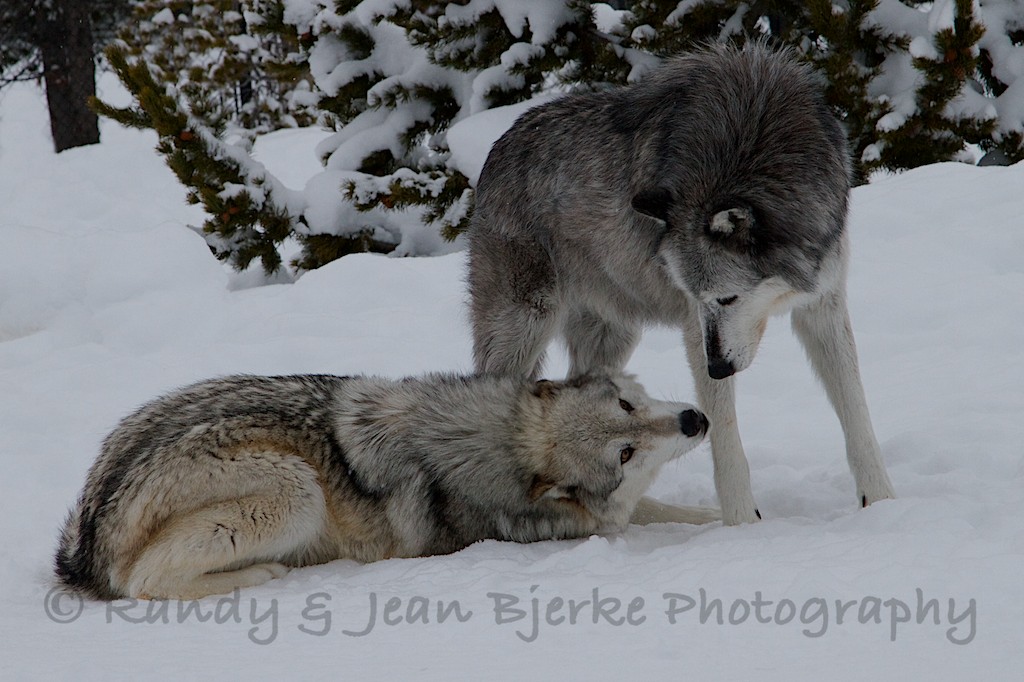
A special treat on our last visit to the Grizzly & Wolf Discovery Center in West Yellowstone was watching the alpha pair of their High Country Pack, McKinley and Adara, play and roughhouse. Adara, the light colored wolf in the next five shots, is the alpha female of her pack and is displaying characteristic submissive behavior to her mate, the alpha male.


McKinley & Adara - alpha pair of High Country Pack


McKinley (standing) & Adara


McKinley & Adara


McKinley & Adara


McKinley & Adara


The four wolves of the High Country Pack are McKinley and Leopold, brothers born in 2006, and Adara and Takoda, sister and brother born in 2009.


Adara & Takoda


Leopold (left) & Takoda

Adara & Takoda


The wolves are especially active around the time they are fed, and periodically in winter they get a carcass.


McKinley feeding


Adara with remains of a carcass


The Gray Wolf (canis lupus) can range in color from white to tan or grizzled gray, to black.  The Gray Wolf was once common throughout North America, but was hunted almost to extinction up to the 1930s. Then wolves were reintroduced to Yellowstone National Park in 1995. Their recovery in the northern Rockies is one of the great successes of the Endangered Species Act, yet they are also the subject of deep and vehement controversy.  


I will not comment here on the intense political controversy over wolves but will simply say that to me, wolves symbolize power and strength, wilderness and wildness. 


Leopold & Takoda


I am drawn to the beautiful Lamar Valley of Yellowstone to observe wild wolves, and there is nothing more awesome than watching these amazing animals in the wild. At the same time, the Grizzly & Wolf Discovery Center is one of my favorite places and a perfect place to observe wolves, as well as grizzlies.

Saturday, December 22, 2012

Trumpeter Swans on Henry's Fork

There is a special magic in observing the graceful Trumpeter Swan. This week we photographed these birds on the Henry's Fork of the Snake River, at Last Chance in Island Park, Idaho - part of the Greater Yellowstone Ecosystem.


It was about an hour before sunset when we arrived at Last Chance and set up our photography equipment. More than a hundred birds were visible on the river, with the late afternoon light catching the pure white of the mature adults beautifully. 


The birds seemed wary when we walked down towards the bank, and moved off in another direction, some swimming, and some taking flight. But if we walked along the road they seemed tolerant of our presence, no doubt having seen plenty of humans and cars in that location.


Periodically some of the birds would seem to stand up on the water, stretching and flapping their wings, or would take off, fly a short distance, and land with another group of birds.


As sunset approached, the swans became more active, with more birds flying up and down the river to land in different locations.


Yellowstone National Park reported this year that "Participants in the West Yellowstone Christmas Bird Count tallied 190 trumpeter swans on the Madison River and nearby open waters adjacent to Yellowstone National Park on December 16th. The Madison and Yellowstone rivers within the park also provide favorable wintering habitat for trumpeters, most of which nest in northern Canada." 


A few thousand swans are reported to winter throughout the Greater Yellowstone Ecosystem. Most of them are birds that nest and spend their summers in Canada. Read more about wintering Trumpeter Swans in Greater Yellowstone in my blog post of last January.


Sunday, October 7, 2012

Fall in Grand Teton National Park


Wondering what you will see on a visit to Grand Teton National Park in October? 

This two minute video highlights dramatic fall color, magnificent views, and wildlife including moose, bear, deer, bison, and pronghorn.


Certain views of the spectacular Grand Teton mountain range have been photographed tens of thousands of times, but each sunrise is still different. It is a surprise, having set out in the dark well before dawn, to see what the sunrise will bring, and in autumn, around the end of September and beginning of October, the fall color is spectacular.


Dawn at Schwabacher Landing

Mt. Moran just before dawn

Dawn at Oxbow Bend

There are more reported moose sightings in October than any other month, but to see a moose you must be in the right place at the right time. To photograph the animal you must also have a great deal of patience. Typically, this bull lay in the sage brush for nearly four hours - showing the moose paparazzi only a wonderful view of his antlers. During this time he stood up only once for 30 seconds. For all we know, he may have laid there another four hours before walking off, as we did not stay longer.


Moose lying in sage brush


Moose are huge animals which can weigh nearly a ton and stand almost 7 feet tall. They feed primarily on vegetation, both on land, and submerged under water. They can even dive - up to 18 feet deep - to feed. They are often found in marshy wetlands, and love to hide in dense brush and willows. It is amazing how quickly such a large animal can disappear into the brush. They are regularly seen along the Snake River, from the Moose-Wilson Road, at Oxbow Bend, at Schwabacher Landing, and also along the Gros Ventre River.

Bull moose near Moose-Wilson Road

Bull moose near Gros Ventre RIver

Bull moose near Gros Ventre River

Bull Moose near Moose-Wilson Road


As with the moose pictured in the sage brush above, many times this animal is first spotted lying in tall grass or sage.

Bull moose in grass

While it is especially thrilling to spot the big bulls with the huge racks of antlers, the cow moose and their calves are also fascinating to watch.


Cow moose feeding in pond

Calf born this spring still stays near his mama


Much of the park provides excellent habitat for bear - both grizzly bear and black bear. In fall they enter a phase called “hyperphagia” in which they eat voraciously in preparation for winter hibernation. These young black bears were photographed along the Moose-Wilson Road.

Cinnamon-colored American Black Bear

Tourists watch American Black Bear on Moose-Wilson Road

The aspens and sycamores turn bright shades of yellow and deep gold in fall. Some bushes turn to red and rust colors. The grasslands glow gold in morning and evening light.

Fall color near Jenny Lake

Aspens on Moose-Wilson Road


Near water, you may see various ducks, Canada geese, and other water fowl. The premier winged fishermen are eagles and osprey.

Osprey with fish

American Bison are an iconic animal of both Grand Teton and Yellowstone National Parks. Huge animals, often found in herds, they can be dangerous and as with other big game, it is important to keep an appropriate distance - federal law requires 25 yards for most of the big animals, and 100 yards for bear and wolf.


American Bison

Pronghorns are a lovely, graceful animal, often found in small groups. It is the fastest animal on land in North America, and is often seen in the open sage grasslands of the park. Antelope Flats and the area along the Gros Ventre River are especially good places to observe pronghorn.

Pronghorns