Gardner Bay
December 24th is the day Ecuadoreans celebrate Christmas. What a day of extraordinary experiences in wild and beautiful places. In the early morning, we kayaked along the rocky lava coast near Gardner Bay, where a yellow warbler hopped by and posed briefly with a sea lion lounging on the rocks.
 |
| Yellow Warbler with Sea Lion |
Next came a wet landing from the panga on the beautiful white sand beach at Gardner Bay.
 |
| Landing at Gardner Bay |
Large numbers of sea lions lay about, many of the females lying in the sun in groups for warmth, some moving around languidly, and all of them barely noticing the human visitors. The young were more active in moving around the beach and playing in the edge of the surf.
 |
| Sea Lions at Gardner Bay |
 |
| Young Sea Lions playing in surf |
 |
| Sea Lion joins girls playing on beach |
Greg warned us to be wary of the big mature males, called "beach masters." Much darker than the females, these big animals can become very protective of their space during the mating season. They did seem fearsome, and we kept our distance from the beach master. On the beach we also saw the Hood Island Mockingbird and Hood Island Lava Lizard.
 |
| Beach Master |
There are four different species of Mockingbird in Galapagos, where speciation has taken place on different islands. Our pocket guide noted that they are best identified by the island on which they are observed. The Hood Island Mockingbird has the longest and most down-curved bill.
 |
| Espanola (Hood Island) Mockingbird |
Our first snorkel of the trip, here in Gardner Bay, was a delightful experience. We saw large schools of Yellow Tailed Surgeonfish, a few King Angelfish and many other colorful fish. The water temperature was 73 degrees F.
Punta Espinoza
In the afternoon, we went ashore via a dry landing at Punta Suarez, an especially photogenic place, for some amazing sights. Greg had told us that this was an excellent time for observing marine iguanas. Food is plentiful, and they are coming into the mating season when the males exhibit more color. On Espanola they take on more red and green, and to me these were the most striking of the Marine Iguanas we saw.
 |
| Marine Iguana at Punta Suarez |
We saw a beautiful pair of adult Galapagos Hawks shortly after landing, as well as striking and graceful Red Billed Tropicbirds.
 |
| Galapagos Hawk |
Along the shore, we observed more Sea Lions and Iguanas.
As we walked inland over uneven lava, we were delighted to see more Blue Footed Boobies, with younger chicks than we had seen on N. Seymour, right by the trail. Typically a pair of boobies will have two chicks, but only one will survive. We felt lucky to see this bird when it still had both chicks.
 |
| Blue Footed Booby with two chicks |
 |
| Blue Footed Booby |
Farther along on our walk we saw a number of the striking Nazca Boobies, including this one incubating an egg.
 |
| Nazca Booby |
 |
| Nazca Boobies |
The the high black lava cliffs of the shoreline of Espanola with surf breaking below is a beautiful sight.
 |
| Nazca Booby and coastline near Punta Suarez |
We saw quite a few lava lizards on this trip, and our guide to "Terrestrial Life of Galapagos" lists three species of these lizards, as well as two geckos, some found only on a single island. The female Espanola Lava Lizard has a distinctive red face and throat.
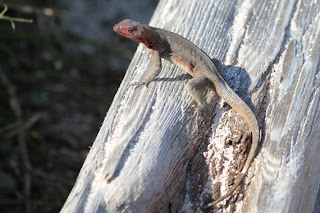 |
| Espanola Lava Lizard (female) |
On the bluffs above the ocean, we had wonderful views of several Waved Albatross, both adults and chicks. We had been told a year before by our tour operator that we would not see Waved Albatross, as they would not be in the islands in December. However, Greg explained that because this is a La Nina year, and one of the strongest he remembers, there has been an upwelling of cooler water than normal around the Galapagos, producing especially nutrient rich waters and more plentiful food for all the animals that depend on the sea for food. So the Waved Albatross was still here.
The large heavy Albatross has difficulty launching into flight from the ground, so they waddle over to the cliff edge and jump off in order to become airborne. We stayed around the albatross about 20 minutes, and just as Greg had described, we watched one of the adults take off into the air in this way.
 |
| Waved Albatross (photo by Sumit Roy) |
We watched an adult feeding a chick, another funny-looking downy chick sitting right by the trail, and even watched a mating display between two adults. This is quite a dance, with head bobbing and beak-clacking in unison while they face each other, all the while flapping their wings and calling out to each other.
 |
| Waved Albatross with chick |
 |
| Waved Albatross chick |
Back on our yacht, the crew had hung a small artificial Christmas wreath on each cabin door, and strung lights in the main areas of the boat including the dining room. The chef had prepared a wonderful roast turkey Christmas feast, including several delicious Ecuadorean side dishes. Another wonderful day during this perfect vacation in Galapagos.
 |
| Sagitta at sunset |
NEXT POST: Floreana - Day 4