Please VISIT OUR WEBSITE

To order images, prints, or cards, click here

Showing posts with label images. Show all posts

Thursday, December 27, 2012

Wolves at Grizzly & Wolf Discovery Center


There is a haunting, wild, beauty about the face of a wolf. 


Leopold - High Country Pack


The more I learn of wolves’ complex social structure the more I am in awe of these magnificent predators, beautiful and fearsome at the same time, amazing hunters able to bring down elk, moose, or bison. To see them in the wild inspires awe. To hear them howl is to experience an indescribably wild sound.


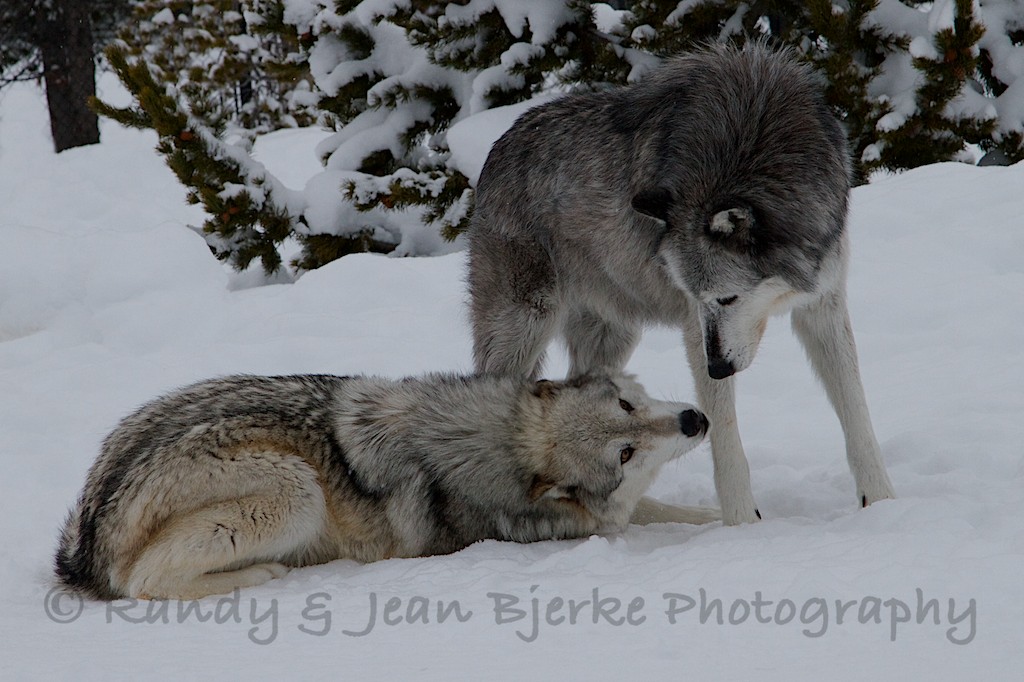
A special treat on our last visit to the Grizzly & Wolf Discovery Center in West Yellowstone was watching the alpha pair of their High Country Pack, McKinley and Adara, play and roughhouse. Adara, the light colored wolf in the next five shots, is the alpha female of her pack and is displaying characteristic submissive behavior to her mate, the alpha male.


McKinley & Adara - alpha pair of High Country Pack


McKinley (standing) & Adara


McKinley & Adara


McKinley & Adara


McKinley & Adara


The four wolves of the High Country Pack are McKinley and Leopold, brothers born in 2006, and Adara and Takoda, sister and brother born in 2009.


Adara & Takoda


Leopold (left) & Takoda

Adara & Takoda


The wolves are especially active around the time they are fed, and periodically in winter they get a carcass.


McKinley feeding


Adara with remains of a carcass


The Gray Wolf (canis lupus) can range in color from white to tan or grizzled gray, to black.  The Gray Wolf was once common throughout North America, but was hunted almost to extinction up to the 1930s. Then wolves were reintroduced to Yellowstone National Park in 1995. Their recovery in the northern Rockies is one of the great successes of the Endangered Species Act, yet they are also the subject of deep and vehement controversy.  


I will not comment here on the intense political controversy over wolves but will simply say that to me, wolves symbolize power and strength, wilderness and wildness. 


Leopold & Takoda


I am drawn to the beautiful Lamar Valley of Yellowstone to observe wild wolves, and there is nothing more awesome than watching these amazing animals in the wild. At the same time, the Grizzly & Wolf Discovery Center is one of my favorite places and a perfect place to observe wolves, as well as grizzlies.

Friday, December 30, 2011

Bighorn Sheep on Christmas Eve

Photo by Randy
Christmas Eve brought a special opportunity to photograph this herd of wintering Bighorn Sheep, on a mountain hillside near Quake Lake, in Montana, not far from Yellowstone National Park.


These are amazing and beautiful animals, extraordinarily sure-footed when navigating high cliffs and rocky mountain terrain, and they are able to survive the harshest Rocky Mountain winters. They can be seen on the rocky crags and ledges near the Quake Lake Visitor Center in summer, and come down lower in winter. 


The most distinctive feature of these animals is the males’ massive curved horns that can weigh up to 30 pounds. Their horns are used both as weapons and in defense during fierce battles between males during the mating season in the fall. 


Male Rocky Mountain Bighorn Sheep can weigh over 300 pounds. They stand up to four feet tall. The females also have horns, but much shorter and straighter. 


Bighorn sheep eat grasses in summer and more woody plants in winter.
Rams compete for ewes during the mating season, charging at each other with a repeated, violent crashing of their huge horns. People say the sound of the clashing horns can sometimes be heard for up to a mile. These fierce battles can go on for 24 hours between two individuals, until one animal gives up and walks away. Amazingly, the special bone structure of their skulls prevents serious injuries most of the time.


As with elk, only the biggest, strongest, most dominant males will mate. The lambs are born the following spring, and can walk soon after birth and climb as well as their mothers within a day.


The herd we photographed consisted of about 30 animals. There were several mature rams, and there appeared to be numerous ewes, yearlings, and two-year-olds, as well as a few lambs who looked like they had been born last spring. Bighorn sheep, which may be gray, light brown, or dark brown, have a white rump and white on the backs of all four legs. Maybe to help camouflage them if they are fleeing a predator?


The Rocky Mountain Bighorn Sheep is one of three subspecies of bighorn sheep found in North America, and its range extends throughout the Rocky Mountains from Canada to the southern U.S. Two other groups of bighorns are listed as endangered: the Sierra Nevada Bighorn of California and the Peninsular Bighorn population of the southwestern desert. 
Photo by Randy


It is thought that at one time, bighorn sheep probably numbered up to 2 million animals in western North America. Due to habitat loss, hunting, competition for food from domestic livestock, and disease from livestock the bighorn sheep population plummeted to unsustainable levels by the middle of the 20th century. Significant efforts at re-introduction have brought them back to a total population estimated at about 70,000 animals.


Sunday, November 27, 2011

Monarch Butterflies at Pismo Beach State Park

One of the wonderful things about winter in southern California is the amazing monarch butterfly migration that brings these beautiful insects from Canada to southern California for the winter.


Photo by Randy
The monarch is the only insect that makes a two-way migration in the same way that many birds do. The butterflies look delicate and fragile, but they travel an astonishing 2,500 to 3,000 miles from their summer range in Canada to southern California or Mexico for the winter. They use three major flyways - along the western coast of North America, down the center of the continent to Texas, and down the east coast. 


Monarchs west of the Rocky Mountains overwinter in southern California and Baja California. Monarchs in the eastern part of the continent fly all the way to the Sierra Madre Mountains of Mexico to overwinter, roosting in oyamel fir forests and clustering together for warmth. Mexico established a Monarch Butterfly Biosphere Reserve in the Sierra Madre in 1986, expanding it in 2000 to include a total of 217 square miles. 


Monarchs live only two to five weeks during the mating season, laying eggs on milkweed plants which in turn provide a food source for the larvae. Several generations of butterflies live and die over the summer, but the last generation of the season does not reproduce and therefore lives longer. These are the butterflies that migrate, and this generation can live eight to nine months. 


Along the California coast and down into Baja California, there are over 300 overwintering sites, among which the best known and most spectacular are in Pacific Grove and Pismo Beach. The largest population of overwintering insects is at Monarch Grove, at Pismo Beach State Park, where these monarchs were photographed. 


From November through February, the insects can usually be easily observed in these locations where they roost in eucalyptus, Monterey pine, and Monterey cypress trees, returning to the same trees year after year. The sight of these beautiful insects clustering in the branches, sometimes by the thousands, is awesome, their delicate beauty magical. There can be as many as ten thousand butterflies on a single tree. 
Photo by Randy


The best conditions to observe the butterflies are on the warmer days, when the monarchs are more active. We were fortunate to visit Monarch Grove at Pismo State Beach the day after Thanksgiving, on a sunny day when the afternoon temperature was about 70 degrees. Most of the butterflies were roosting, some of them in huge clusters, but many were also flitting and fluttering about.


In February and March, the butterflies that overwintered begin to breed as they travel north, laying eggs on milkweeds along their way. However, the butterflies do not live long after breeding. The generation that migrated south the previous fall dies soon after reproducing, shortly after the spring migration begins. Their offspring continue the migration, with each generation traveling farther north, and it takes three to four generations to reach their summer range. 


The monarchs’ migration patterns are a subject of both fascination and scientific research. It is one of the particularly astonishing mysteries of nature, that the individual butterflies that summer in Canada or winter in California are several generations removed from each other, and no individual butterfly migrates both ways. 


Friday, October 28, 2011

Elk Rut in Yellowstone

This year was the first time we observed the elk rut in Yellowstone - an amazing wildlife phenomenon. During the mating season, which begins in September and lasts into October, males bugle their superiority over a herd of females, and bulls can clash fiercely as they vie for the dominant position in a herd. 
For years we had looked forward to hearing the sounds of the bugling elk and observing the animals during the rut. By Labor Day, people had begun to hear bugling elk at a distance in the fir forest on the ridge of the continental divide behind our cabin near Yellowstone. But no one had yet seen a mature bull. The males retreat to higher elevations and the cover of forest during the summer and are seldom seen until they come to lower elevations, seeking the females, or cows, during the rut, or mating season.
On Labor Day weekend, we spotted this “spike elk” (no branching of the antlers) near Mammoth in Yellowstone National Park. He appeared a beautiful, healthy, strong, proud animal. But likely he would not mate this year, as he would probably not win out in a fight with a mature bull. The rangers at Mammoth told us they had heard bugling in the distance but had not yet seen “the big guys.”


Spike Elk near Mammoth - Yellowstone National Park
The bugling of the males is a unique and unforgettable sound. Randy first heard this call aweek later in the Madison River valley east of West Yellowstone in the national park. Bulls normally bugle from a standing position, but this one was bugling while lying in the grass. 


Elk in Grass Bugling - Madison Valley, Yellowstone - photo by Randy
Several females, or cows, were lying in the grass or standing on the bank, on the opposite side of the river. They were calling to him and he seemed to be bugling in reply.


Photo by Randy
Photo by Randy
In mid September, we spotted this magnificent 6x7 bull lying in the tall golden grass of autumn, again along the Madison west of Madison Junction, with four females nearby. Such a beauty.


6x7 Elk, Madison River Valley, Yellowstone National Park

As no other bulls seemed to be in the general vicinity, this small group of animals appeared pretty relaxed. The bull eventually got to his feet, leisurely walking over to each of the females in turn.


Photo by Randy


Elk Pair - Bull and Cow - Madison River Valley, Yellowstone

With one of them, he smelled her private parts, then let out a plaintive bugle. We don’t know what he was saying but it surely seemed like a sexual plea. The male is ready to mate, but the female is only ready one day out of twenty, based on her estrus cycle.

Elk, also called by the Native American name “wapiti,” are a large and impressive animal and a common sight in Yellowstone National Park, although females are seen much more frequently than males, and the bulls are not commonly seen in summer. These animals, especially the males during the rut, can be very dangerous. They have been known to charge people and even vehicles, and they can cause a lot of damage to a car! Rangers recommend staying at least 75 yards from an elk.


Once found across North America, elk are now found mostly in places like Yellowstone or the National Elk Refuge in Wyoming. A large bull elk may weigh between 700 and 1,100 pounds and stand up to 5 feet at the shoulder with antlers that can reach as much as four feet above above his head. 


Photo by Randy
Calves are born in early summer. The bull loses his antlers in March, and grows new ones annually by the time of the breeding season in September and October.  In winter, herds of elk migrate to lower elevations where feeding is easier. In the Greater Yellowstone area, many elk migrate out of the park in winter, to these lower elevations. One of their routes goes through the valley overlooked by our cabin and over Raynolds Pass at the Montana border, into the lower Madison Valley around Ennis.


Photo by Randy