Please VISIT OUR WEBSITE

To order images, prints, or cards, click here

Showing posts with label Pronghorn. Show all posts

Sunday, October 7, 2012

Fall in Grand Teton National Park


Wondering what you will see on a visit to Grand Teton National Park in October? 

This two minute video highlights dramatic fall color, magnificent views, and wildlife including moose, bear, deer, bison, and pronghorn.


Certain views of the spectacular Grand Teton mountain range have been photographed tens of thousands of times, but each sunrise is still different. It is a surprise, having set out in the dark well before dawn, to see what the sunrise will bring, and in autumn, around the end of September and beginning of October, the fall color is spectacular.


Dawn at Schwabacher Landing

Mt. Moran just before dawn

Dawn at Oxbow Bend

There are more reported moose sightings in October than any other month, but to see a moose you must be in the right place at the right time. To photograph the animal you must also have a great deal of patience. Typically, this bull lay in the sage brush for nearly four hours - showing the moose paparazzi only a wonderful view of his antlers. During this time he stood up only once for 30 seconds. For all we know, he may have laid there another four hours before walking off, as we did not stay longer.


Moose lying in sage brush


Moose are huge animals which can weigh nearly a ton and stand almost 7 feet tall. They feed primarily on vegetation, both on land, and submerged under water. They can even dive - up to 18 feet deep - to feed. They are often found in marshy wetlands, and love to hide in dense brush and willows. It is amazing how quickly such a large animal can disappear into the brush. They are regularly seen along the Snake River, from the Moose-Wilson Road, at Oxbow Bend, at Schwabacher Landing, and also along the Gros Ventre River.

Bull moose near Moose-Wilson Road

Bull moose near Gros Ventre RIver

Bull moose near Gros Ventre River

Bull Moose near Moose-Wilson Road


As with the moose pictured in the sage brush above, many times this animal is first spotted lying in tall grass or sage.

Bull moose in grass

While it is especially thrilling to spot the big bulls with the huge racks of antlers, the cow moose and their calves are also fascinating to watch.


Cow moose feeding in pond

Calf born this spring still stays near his mama


Much of the park provides excellent habitat for bear - both grizzly bear and black bear. In fall they enter a phase called “hyperphagia” in which they eat voraciously in preparation for winter hibernation. These young black bears were photographed along the Moose-Wilson Road.

Cinnamon-colored American Black Bear

Tourists watch American Black Bear on Moose-Wilson Road

The aspens and sycamores turn bright shades of yellow and deep gold in fall. Some bushes turn to red and rust colors. The grasslands glow gold in morning and evening light.

Fall color near Jenny Lake

Aspens on Moose-Wilson Road


Near water, you may see various ducks, Canada geese, and other water fowl. The premier winged fishermen are eagles and osprey.

Osprey with fish

American Bison are an iconic animal of both Grand Teton and Yellowstone National Parks. Huge animals, often found in herds, they can be dangerous and as with other big game, it is important to keep an appropriate distance - federal law requires 25 yards for most of the big animals, and 100 yards for bear and wolf.


American Bison

Pronghorns are a lovely, graceful animal, often found in small groups. It is the fastest animal on land in North America, and is often seen in the open sage grasslands of the park. Antelope Flats and the area along the Gros Ventre River are especially good places to observe pronghorn.

Pronghorns

Friday, July 16, 2010

Yellowstone

Yellowstone is a sacred place to me, a place of immense natural beauty, awesome scenery, abundant and amazing wildlife, unique and wondrous geothermal features. 


Lower Yellowstone Falls

Bison grazing in Lamar Valley

Pond near Swan Lake
Ledge Geyser (l) & Black Growler Steam Vent - Norris
Each season offers special opportunities to observe wildlife, and by early to mid June, visitors can spot black and grizzly bears with their cubs, wolves with their pups, bison and elk with their calves, and pronghorn with their fawns. In the Madison River Valley, we enjoyed watching a herd of bison cows with their calves, as they walked along the river, several of the animals swimming back and forth across the water.
Bison with two calves

Bison mother and calf ford Madison River

Bull Bison calf

A pair of sandhill cranes were followed through the grass by their chick, who mimicked their every move.

Sandhill Cranes
Sandhill Crane with chick


Bighorn Ram


In the beautiful and wild Lamar Valley, in the undeveloped northeastern corner of the park, we saw hundreds of elk and bison, as well as a majestic bighorn ram, and two female pronghorns with their fawns.


Pronghorn females with fawns


Pronghorn nursing


Staying overnight in nearby Silver Gate, we were up well before dawn to join other wolf watchers with our rented high-power spotting scope, and were rewarded with the opportunity to watch the five adult wolves and four pups of the Silver Pack just as the sun rose.

The animals were much too far away for photographing the wolves, but from high on a sage-covered hillside on the north side of the valley, we watched the pups romp and play, and the adults lounge about, in the early morning sunlight. 
Later in the day we watched two of the three adults and two of the three pups of the newly-named Lamar Canyon Pack, near the location known to experienced wolf-watchers as the den of the former Slough Creek Pack, which the new group used this season to have their pups.


Bald Eagle with "chick" a few days before fledging
A highlight of our first visit to Yellowstone this season was watching a bald eagle nest, with one young bird who was testing his wings and flight skills just days before he fledged.
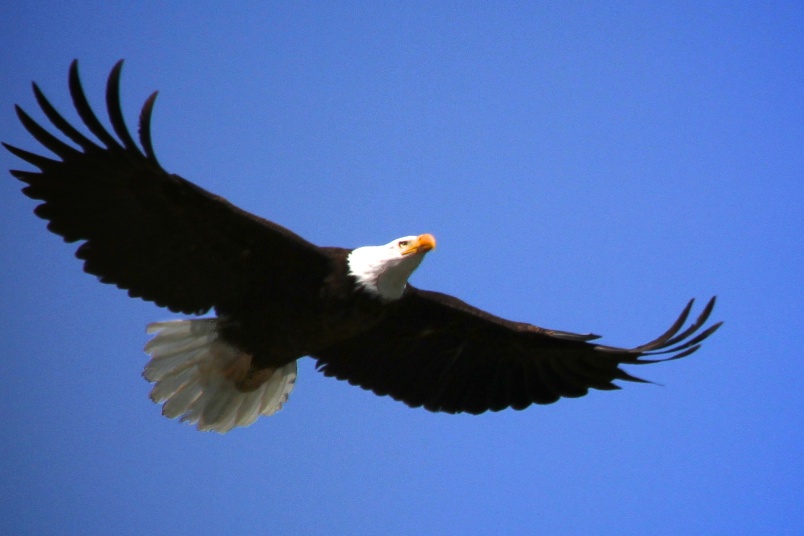
The adult eagles in flight were magnificent - more than worthy of being identified as our national symbol.
Bald Eagle adult


Firehole River, Midway Geyser Basin


On another visit to the park, we stopped along the Firehole River where it meandered through the Midway Geyser Basin.


A great blue heron in full breeding plumage preened on the opposite bank, in a colorful wildflower meadow of purple larskpur and other flowers. The fancy plumes are only present in breeding adults, and although I have watched great blue herons all over North America for more than thirty years, this was the best opportunity I have had to watch and photograph such a beauty.


Great Blue Heron in breeding plumage


Old Faithful Geyser

Old Faithful is the most famous geyser in the world, attracting tens of thousands of visitors annually to observe its regular eruptions which occur about every hour to 90 minutes and last from one-and-a-half  to five minutes.

Grand Prismatic Spring 


Grand Prismatic Spring is not far from Old Faithful, and is one of the largest and most colorful of the hot springs in the park. The color of the hot springs comes from microbes living in the hot water - and varies from blue through orange depending on the temperature.