Please VISIT OUR WEBSITE

To order images, prints, or cards, click here

Showing posts with label Yellowstone. Show all posts

Saturday, December 22, 2012

Trumpeter Swans on Henry's Fork

There is a special magic in observing the graceful Trumpeter Swan. This week we photographed these birds on the Henry's Fork of the Snake River, at Last Chance in Island Park, Idaho - part of the Greater Yellowstone Ecosystem.


It was about an hour before sunset when we arrived at Last Chance and set up our photography equipment. More than a hundred birds were visible on the river, with the late afternoon light catching the pure white of the mature adults beautifully. 


The birds seemed wary when we walked down towards the bank, and moved off in another direction, some swimming, and some taking flight. But if we walked along the road they seemed tolerant of our presence, no doubt having seen plenty of humans and cars in that location.


Periodically some of the birds would seem to stand up on the water, stretching and flapping their wings, or would take off, fly a short distance, and land with another group of birds.


As sunset approached, the swans became more active, with more birds flying up and down the river to land in different locations.


Yellowstone National Park reported this year that "Participants in the West Yellowstone Christmas Bird Count tallied 190 trumpeter swans on the Madison River and nearby open waters adjacent to Yellowstone National Park on December 16th. The Madison and Yellowstone rivers within the park also provide favorable wintering habitat for trumpeters, most of which nest in northern Canada.


A few thousand swans are reported to winter throughout the Greater Yellowstone Ecosystem. Most of them are birds that nest and spend their summers in Canada. Read more about wintering Trumpeter Swans in Greater Yellowstone in my blog post of last January.


Tuesday, September 4, 2012

Bull Elk #10 in Yellowstone


This magnificent bull was resting not far from the road, in the late afternoon. We spotted him on September 2, 2012 near the road between Sheepeater Cliff and Mammoth in Yellowstone, and of course immediately noticed the yellow tag in his ear. He turned out to be the "famous" bull elk #10 that others have photographed and written about. 

Bull Elk #10 in Yellowstone ~ Jean Bjerke photo


As typically happens in Yellowstone, he had attracted an admiring small crowd, who wisely kept their distance. Park rules require humans to stay at least 25 yards from this massive animal.


Bull Elk #10 resting near Blacktail Ponds ~ Randy Bjerke


Curious whether we could find records of bull elk #10, we found mention of him in Beth Pratt's blog from September 2008, when her pictures showed him to be a beautiful 6x6-point bull. In February 2009 Kurt Repanshek wrote in his National Parks Traveler about the death of another well-known elk, bull elk #6, characterizing these two bulls as having been arch-rivals. In January 2011, artist and sculptor George Bumann photographed bull elk #10 near Blacktail Ponds, and by this time the bull had a beautiful, even seven-point rack of antlers. Bumann wrote "I sure hope that we will get to see him next autumn!"  In June 2012, the Guidebook of Yellowstone Wildlife reported that bull elk #10, "one of the most popular bulls in the park," was spotted near Blacktail Ponds. A google search turned up some beautiful images and several videos of this bull. What a privilege to see him ourselves!

Bull Elk #10 - Note perfect 7x7-point rack ~ Jean Bjerke


Bull Elk #10 ~ Jean Bjerke


Well, he is back! He looks good, well-fed, with his coat in good shape. A beautiful animal, he will no doubt again be one of the dominant males during the elk rut in Yellowstone


Bull Elk #10 ~ Jean Bjerke

Wondering how he came to be tagged? Al Nash, Public Affairs Officer in Yellowstone National Park, provided this explanation to Elizabeth Laden, editor of the Island Park News: "Several years ago, this particular elk managed to get a badminton net and poles wrapped around his antlers. He had to be darted and immobolized to remove the items. The FDA has concerns over potential impacts the chemical residue may have if humans consume the meat within a certain period of time. Tagging the animal serves as a flag to hunters to check on the history of the animal if harvested."


Bull Elk #10 ~ Randy Bjerke

Monday, August 30, 2010

Pelicans

Pelicans are such strange and unlikely looking birds, with their plump bodies, very long bills, and large pouches for scooping up fish. Years ago, as I was swimming in the Pacific off Santa Monica Beach, a brown pelican dove for fish within five feet of me. What an  awesome sight. In flight the pelican has a wingspan of up to ten feet. When it sees fish beneath the surface of the water, the bird folds its wings and plummets head first into the water, where it scoops up as many fish as it can, into the large pouch below its bill.

Shown here are White Pelicans, photographed on the Madison River in Montana.There are two species in North America, the Brown Pelican, found along ocean coasts, and the White Pelican, found throughout inland North America. White Pelicans are often seen in Yellowstone National Park and the Greater Yellowstone area.


In the sequence below, a parent approached an immature bird to offer it food. The immature pelican is as large as the parent, and is distinguished by the brownish feathers on its crown, in contrast to the pure white of the adult.


Friday, July 16, 2010

Yellowstone

Yellowstone is a sacred place to me, a place of immense natural beauty, awesome scenery, abundant and amazing wildlife, unique and wondrous geothermal features. 


Lower Yellowstone Falls

Bison grazing in Lamar Valley

Pond near Swan Lake
Ledge Geyser (l) & Black Growler Steam Vent - Norris
Each season offers special opportunities to observe wildlife, and by early to mid June, visitors can spot black and grizzly bears with their cubs, wolves with their pups, bison and elk with their calves, and pronghorn with their fawns. In the Madison River Valley, we enjoyed watching a herd of bison cows with their calves, as they walked along the river, several of the animals swimming back and forth across the water.
Bison with two calves

Bison mother and calf ford Madison River

Bull Bison calf

A pair of sandhill cranes were followed through the grass by their chick, who mimicked their every move.

Sandhill Cranes
Sandhill Crane with chick


Bighorn Ram


In the beautiful and wild Lamar Valley, in the undeveloped northeastern corner of the park, we saw hundreds of elk and bison, as well as a majestic bighorn ram, and two female pronghorns with their fawns.


Pronghorn females with fawns


Pronghorn nursing


Staying overnight in nearby Silver Gate, we were up well before dawn to join other wolf watchers with our rented high-power spotting scope, and were rewarded with the opportunity to watch the five adult wolves and four pups of the Silver Pack just as the sun rose.

The animals were much too far away for photographing the wolves, but from high on a sage-covered hillside on the north side of the valley, we watched the pups romp and play, and the adults lounge about, in the early morning sunlight. 
Later in the day we watched two of the three adults and two of the three pups of the newly-named Lamar Canyon Pack, near the location known to experienced wolf-watchers as the den of the former Slough Creek Pack, which the new group used this season to have their pups.


Bald Eagle with "chick" a few days before fledging
A highlight of our first visit to Yellowstone this season was watching a bald eagle nest, with one young bird who was testing his wings and flight skills just days before he fledged.
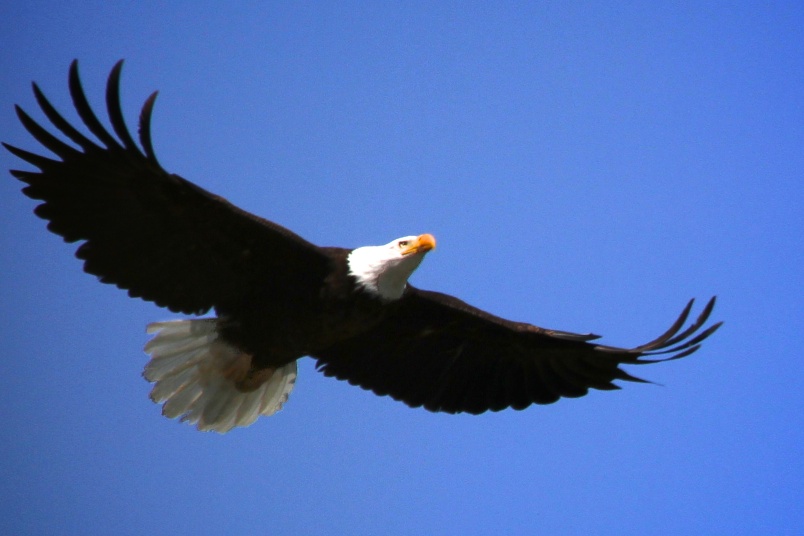
The adult eagles in flight were magnificent - more than worthy of being identified as our national symbol.
Bald Eagle adult


Firehole River, Midway Geyser Basin


On another visit to the park, we stopped along the Firehole River where it meandered through the Midway Geyser Basin.


A great blue heron in full breeding plumage preened on the opposite bank, in a colorful wildflower meadow of purple larskpur and other flowers. The fancy plumes are only present in breeding adults, and although I have watched great blue herons all over North America for more than thirty years, this was the best opportunity I have had to watch and photograph such a beauty.


Great Blue Heron in breeding plumage


Old Faithful Geyser

Old Faithful is the most famous geyser in the world, attracting tens of thousands of visitors annually to observe its regular eruptions which occur about every hour to 90 minutes and last from one-and-a-half  to five minutes.

Grand Prismatic Spring 


Grand Prismatic Spring is not far from Old Faithful, and is one of the largest and most colorful of the hot springs in the park. The color of the hot springs comes from microbes living in the hot water - and varies from blue through orange depending on the temperature.