Please VISIT OUR WEBSITE

To order images, prints, or cards, click here

Showing posts with label photographs. Show all posts

Thursday, December 27, 2012

Wolves at Grizzly & Wolf Discovery Center


There is a haunting, wild, beauty about the face of a wolf. 


Leopold - High Country Pack


The more I learn of wolves’ complex social structure the more I am in awe of these magnificent predators, beautiful and fearsome at the same time, amazing hunters able to bring down elk, moose, or bison. To see them in the wild inspires awe. To hear them howl is to experience an indescribably wild sound.


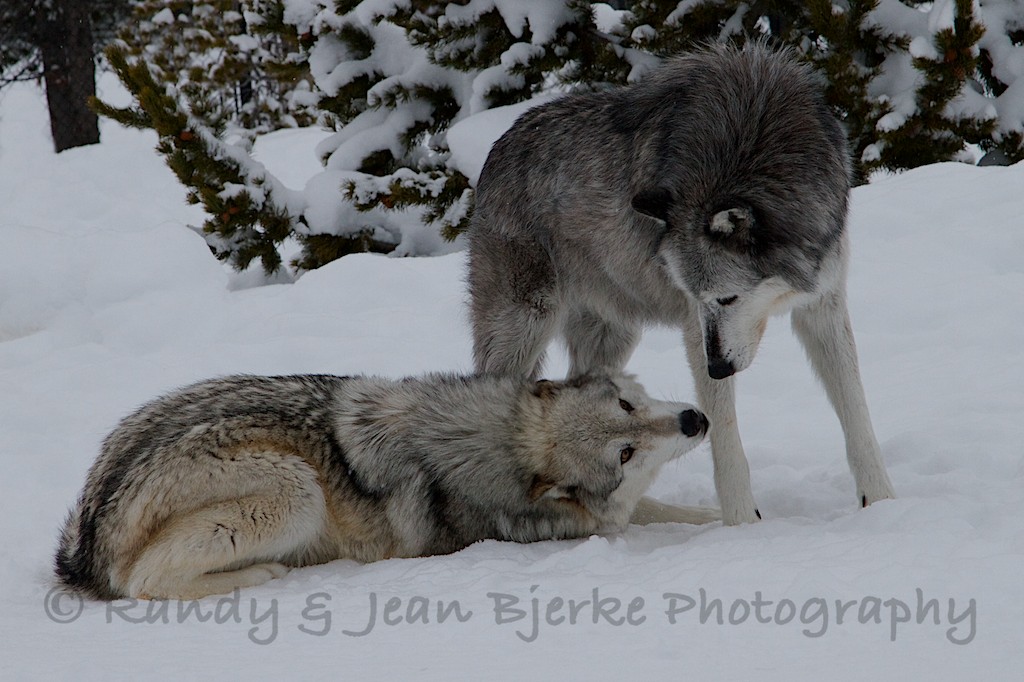
A special treat on our last visit to the Grizzly & Wolf Discovery Center in West Yellowstone was watching the alpha pair of their High Country Pack, McKinley and Adara, play and roughhouse. Adara, the light colored wolf in the next five shots, is the alpha female of her pack and is displaying characteristic submissive behavior to her mate, the alpha male.


McKinley & Adara - alpha pair of High Country Pack


McKinley (standing) & Adara


McKinley & Adara


McKinley & Adara


McKinley & Adara


The four wolves of the High Country Pack are McKinley and Leopold, brothers born in 2006, and Adara and Takoda, sister and brother born in 2009.


Adara & Takoda


Leopold (left) & Takoda

Adara & Takoda


The wolves are especially active around the time they are fed, and periodically in winter they get a carcass.


McKinley feeding


Adara with remains of a carcass


The Gray Wolf (canis lupus) can range in color from white to tan or grizzled gray, to black.  The Gray Wolf was once common throughout North America, but was hunted almost to extinction up to the 1930s. Then wolves were reintroduced to Yellowstone National Park in 1995. Their recovery in the northern Rockies is one of the great successes of the Endangered Species Act, yet they are also the subject of deep and vehement controversy.  


I will not comment here on the intense political controversy over wolves but will simply say that to me, wolves symbolize power and strength, wilderness and wildness. 


Leopold & Takoda


I am drawn to the beautiful Lamar Valley of Yellowstone to observe wild wolves, and there is nothing more awesome than watching these amazing animals in the wild. At the same time, the Grizzly & Wolf Discovery Center is one of my favorite places and a perfect place to observe wolves, as well as grizzlies.

Sunday, July 15, 2012

Moose at Big Springs, Headwaters of Henry's Fork


We have long been fascinated by this massive animal with the strange, homely, primitive looking face, and the impressive rack of antlers on the males. Despite having seen a number of moose, we had found the moose elusive to photograph.

Moose at headwaters of Henry's Fork below Big Springs ~ Jean Bjerke

One afternoon in early July, at Big Springs, at the headwaters of the famous Henry's Fork, a bull moose walked across the river as we were watching the huge trout in the sparkling clear water from Big Springs. Big Springs produces 120 million gallons of water a day and forms the headwaters of the Henry’s Fork of the Snake River. This moose had chosen a lovely area to live.


Moose lying in grass near Henry's Fork of Snake River ~ Randy Bjerke

Having crossed the river and stepped out onto the bank, the moose walked only another 20 feet or so before lying down to rest and chew his cud on this warm afternoon. We watched him for close to three hours during which his only change of position was to walk another ten yards to lie down in another spot. During most of this time the tall grass obscured his face sufficiently to prevent good photographs, but he did raise his head a few times.


Moose raising head from grass ~ Jean Bjerke

Our patience finally paid off when, at about 5:30 PM, he got up and walked through the woods, across a marshy area of deep standing water, and back to the river, browsing on willow leaves and grass, feeding on submerged vegetation in the river, and climbing out to chomp on the bushes on the opposite bank. It was thrilling to watch him and he did not seem concerned by our presence at a respectful distance.  


This 47-second video captures his behavior as he waded the river, fed in the river, and walked along the opposite bank browsing on leaves of the bushes.


Moose browsing on willow leaves ~ Randy Bjerke


Moose walking towards camera ~ Randy Bjerke

The moose is a huge animal, standing up to seven feet tall, and males can weigh up to 1,000 pounds. The males’ enormous antlers can span up to six feet - the record sizes usually come from Alaska. The antlers are shed each winter, and begin to grow again in the spring, reaching complete growth in September. Each set of antlers grows larger than the prior year’s until the moose reaches its prime. 


Moose walking through woods ~ Jean Bjerke

Moose have a long face, and a flap of skin called a bell hangs from their throat. Their range extends across much of the northern part of North America.


Moose walking by Henry's Fork below Big Springs ~ Jean Bjerke

Moose are herbivores, and are equally comfortable in the water where they swim well and often feed on aquatic vegetation, or on land where they can run up to 35 mph. They are often seen in streams, lakes, wetlands, or browsing vegetation such as willows. When a moose feeds on underwater vegetation, it submerges nearly the whole head, and when the animal raises its head, water gushes from its mouth, and often strands of green vegetation can be seen trailing from the mouth.


Moose drool ~ Jean Bjerke

Moose are found throughout the Greater Yellowstone and Grand Teton National Park areas which are home to about 600-800 of the animals.  They are seen much less frequently in Yellowstone than in Grand Teton, which offers more of their preferred and wetter habitat. Sightings are more common in certain months such as October and November. They are also regularly seen in Island Park, the location of Big Springs.