Please VISIT OUR WEBSITE

To order images, prints, or cards, click here

Showing posts with label Greater Yellowstone. Show all posts

Thursday, December 27, 2012

Wolves at Grizzly & Wolf Discovery Center


There is a haunting, wild, beauty about the face of a wolf. 


Leopold - High Country Pack


The more I learn of wolves’ complex social structure the more I am in awe of these magnificent predators, beautiful and fearsome at the same time, amazing hunters able to bring down elk, moose, or bison. To see them in the wild inspires awe. To hear them howl is to experience an indescribably wild sound.


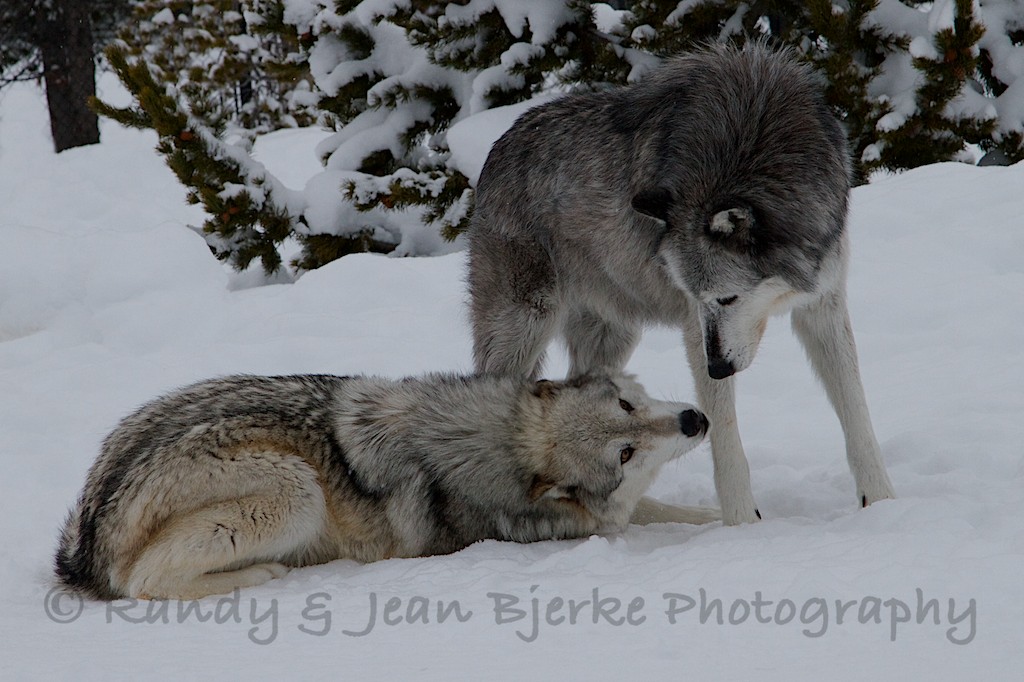
A special treat on our last visit to the Grizzly & Wolf Discovery Center in West Yellowstone was watching the alpha pair of their High Country Pack, McKinley and Adara, play and roughhouse. Adara, the light colored wolf in the next five shots, is the alpha female of her pack and is displaying characteristic submissive behavior to her mate, the alpha male.


McKinley & Adara - alpha pair of High Country Pack


McKinley (standing) & Adara


McKinley & Adara


McKinley & Adara


McKinley & Adara


The four wolves of the High Country Pack are McKinley and Leopold, brothers born in 2006, and Adara and Takoda, sister and brother born in 2009.


Adara & Takoda


Leopold (left) & Takoda

Adara & Takoda


The wolves are especially active around the time they are fed, and periodically in winter they get a carcass.


McKinley feeding


Adara with remains of a carcass


The Gray Wolf (canis lupus) can range in color from white to tan or grizzled gray, to black.  The Gray Wolf was once common throughout North America, but was hunted almost to extinction up to the 1930s. Then wolves were reintroduced to Yellowstone National Park in 1995. Their recovery in the northern Rockies is one of the great successes of the Endangered Species Act, yet they are also the subject of deep and vehement controversy.  


I will not comment here on the intense political controversy over wolves but will simply say that to me, wolves symbolize power and strength, wilderness and wildness. 


Leopold & Takoda


I am drawn to the beautiful Lamar Valley of Yellowstone to observe wild wolves, and there is nothing more awesome than watching these amazing animals in the wild. At the same time, the Grizzly & Wolf Discovery Center is one of my favorite places and a perfect place to observe wolves, as well as grizzlies.

Saturday, December 22, 2012

Trumpeter Swans on Henry's Fork

There is a special magic in observing the graceful Trumpeter Swan. This week we photographed these birds on the Henry's Fork of the Snake River, at Last Chance in Island Park, Idaho - part of the Greater Yellowstone Ecosystem.


It was about an hour before sunset when we arrived at Last Chance and set up our photography equipment. More than a hundred birds were visible on the river, with the late afternoon light catching the pure white of the mature adults beautifully. 


The birds seemed wary when we walked down towards the bank, and moved off in another direction, some swimming, and some taking flight. But if we walked along the road they seemed tolerant of our presence, no doubt having seen plenty of humans and cars in that location.


Periodically some of the birds would seem to stand up on the water, stretching and flapping their wings, or would take off, fly a short distance, and land with another group of birds.


As sunset approached, the swans became more active, with more birds flying up and down the river to land in different locations.


Yellowstone National Park reported this year that "Participants in the West Yellowstone Christmas Bird Count tallied 190 trumpeter swans on the Madison River and nearby open waters adjacent to Yellowstone National Park on December 16th. The Madison and Yellowstone rivers within the park also provide favorable wintering habitat for trumpeters, most of which nest in northern Canada." 


A few thousand swans are reported to winter throughout the Greater Yellowstone Ecosystem. Most of them are birds that nest and spend their summers in Canada. Read more about wintering Trumpeter Swans in Greater Yellowstone in my blog post of last January.


Friday, September 21, 2012

Tribute to Elizabeth Laden


"We say that the hour of death cannot be forecast, but when we say this we imagine that hour as placed in an obscure and distant future.  It never occurs to us that it has any connection with the day already begun or that death could arrive this same afternoon, this afternoon which is so certain and which has every hour filled in advance."  
            ~Marcel Proust

Yesterday, the Greater Yellowstone and Henry’s Fork country lost one of its greatest leaders and advocates. It is with a heavy heart and a deep sense of loss that I write this tribute to our friend Elizabeth Laden, editor of the Island Park News.

My husband Randy and I contributed many photos to the IPNews, which she edited and published with her husband John Losch, and we had much interaction about our submissions. She was always enthusiastic and appreciative, even when she did not publish them. 

She called herself CalderaGal. She had a deep appreciation for nature, wildlife, and the environment as well as a profound commitment to bettering the community. She was a free spirit, "into a lot of things," and had more interesting experiences than most, as recalled by her brother in his blog post "My Sister Died Yesterday." She was patriotic in the best way, expressed strong spiritual values, and had such a positive spirit. She cared deeply about helping people, and about issues large and small. As editor of the newspaper and a mainstay of the community, people in Island Park called her about all sorts of things. Recently in response to one of these calls, she spent a day reuniting a family with a lost dog that had ended up with a different family when someone else who found it  “gave it away.” 


Elizabeth printed this photo of Targhee Peak from Flat Ranch weekly last season,
along with the notice of upcoming programs at the Flat Ranch

When she reported in a moving article, on attending a special ceremony in memory of bison killed in 2007-2008, when they strayed outside of Yellowstone, she quoted Arvol Looking Horse, Lakota chief and spiritual leader, as saying,
"Yellowstone . . . is sacred ground. It has been a sacred site for the First Nation's people, and for all humanity who hold deep respect for all Creation. . . . This understanding is how we maintain the balance upon Grandmother Earth, to protect these places, especially for the survival of our future generations to come . . . We must pray for the healing of the human Spirit, to understand the connection to all living beings on Grandmother Earth."
I sensed she felt a deep kinship to this spirituality.

Frequently I learned from her at unexpected times. When I sent her an image of a rare flower hoping she might want to publish it, she replied in an email with the subject line “beware of rare,” explaining how fragile this plant is, how too much attention will lead to its destruction, how even walking near the plant, can upset the soil and root system such that the plant would not survive. Therefore she would never publish a picture of it to confirm it even lived in Island Park. I promised never to tell where I photographed the flower. The people on whose property the flower bloomed, and still grows, have seen and admired the image. They asked where the picture was taken and I told them I promised Elizabeth I wouldn’t say. They have no idea it was actually on their property.

When I sent her an image of a pronghorn in Yellowstone this summer, she said it was a great photo of the animal but it broke her heart to see him standing in noxious weeds. That led to an exchange about the extent of noxious weeds in the national park and throughout Island Park, a situation that very much distressed her. Now when I look at the photo I see the noxious weeds instead of the pronghorn, and I really don’t like that photo any more. We sell other photos but I don’t expect to print that one for sale.

Elizabeth cared deeply about preserving the beautiful Henry's Fork

When I recently sent her an image of a magnificent perfect 7 point bull elk, photographed in Yellowstone, with a tag in his ear, she said it was a great photo of a majestic animal, but she didn’t like the tag. However, for the newspaper, the tag would have to be in the picture if she used it. Ever the inquisitive reporter, she inquired with the Yellowstone National Park PR office about the tag and shared with me that she learned this particular animal had once gotten a badminton net and poles wrapped around his antlers, had to be darted and sedated to remove them, and the FDA was concerned about the possible risk if he were “harvested” and humans ingested the meat within a certain period of time, so the tag was a warning to hunters to check his history. Fascinating.

Through the newspaper, her many professional contacts, the boards and organizations she was involved in, and her wide network of interests and personal contacts, her influence built community, and she was always at the heart of it. Her brother put it this way:

“Wherever Elizabeth lived . . . a commune named Joy Tribe, a farm in the foothills, West Yellowstone, a small town in the Idaho mountains, she became a core member of a community, a community that probably would not have even existed had she not been there . . .”             - Greg Laden

I always enjoyed the Caldera Cat Tales column in the newspaper, written by Smokey the Wild Cat (with help from a great ghost writer!), and I was a Facebook “fan” of Smokey’s write-in campaign for Fremont County Prosecuting Attorney. Elizabeth’s lighthearted, humorous approach to commenting on daily life (including her own), or local happenings, or the political scene, through Smokey’s observations was so refreshing.

Randy's and my hearts go out to her family, her husband, her children and grandchildren. Her passing is an unfathomable loss to hundreds of people and to the entire community of Island Park. She lived a rich, full, and productive life, was loved and appreciated by many, and gave much to contribute to others’ quality of life, including hundreds of people she didn’t even know. She leaves an amazing legacy, which will improve life in Island Park for many years to come. But she should have lived another 25-30 years. She gave so much, but had so much more to give. She will be deeply missed by more people than she probably ever would have imagined.

May her spirit soar forever with the eagles in beautiful clear blue skies above the Island Park Caldera, and run with the bison through mountain meadows full of wildflowers, and lush forests, along beautiful rivers like the Henry’s Fork that she so loved.


Monday, July 25, 2011

Celebrating the Conservation Easement on the 2Lazy2 Ranch

View of Henry's Lake across 2Lazy2 Ranch in July


For over a decade, we have walked in summer and snowshoed or skied in winter along part of the western perimeter of the 2Lazy2 Ranch (love that name!) north of Henry’s Lake in Island Park, Idaho. From our cabin bordering the 2Lazy2, we have watched bald eagles soar, and red tailed hawks and marsh hawks hunt over the sagebrush grassland of the valley. My favorite wild sound on the 2Lazy2 in summer is the wild and primitive call of the sandhill cranes that nest here; after the grazing cattle arrive each summer, their lowing is the dominant sound on the ranch. 


Black Mountain & 2Lazy2 in winter


Nestled between Black Mountain, Henry’s Lake, and the Continental Divide, with views of Mt. Sawtelle, the Centennial Range, and Two Top Mountain, the 2Lazy2 is a working ranch in a spectacular mountain setting. Its 700 acres spread over much of the area between the north shore of Henry’s Lake and Raynolds Pass at the Montana border. Fox and coyotes pursue their prey; wolves occasionally prowl and run; sandhill cranes mate; trumpeter swans and Canada geese fly overhead, and white pelicans soar over this beautiful land, all of them seemingly paying no attention to the cattle that graze here in summer. Trout from Henry’s Lake come up the stream that flows through the ranch to spawn. 


Cattle grazing on 2Lazy2 ~ Centennial Range in distance

View of Two Top Mountain across 2Lazy2
The ranch is used by elk, moose, pronghorn, deer, and other wildlife. It has a key position on two major wildlife migration routes. The 2Lazy2 is located on the north-south migration route for about 300 pronghorn of the Madison Valley herd who migrate annually over Raynolds Pass. It is also on the east-west migration corridor for grizzly and black bears, mountain lions, wolves and wolverines who move between the Greater Yellowstone and the Centennial Mountains. 
2Lazy2 and Black Mountain in spring


In spring, wildflowers spread exuberant colors between the ranch land and the fir forest and aspen groves that lie near the ranch on the west and the sage-covered slopes on the east. Following summer afternoon thunder showers, beautiful rainbows often appear over the 2Lazy2. In late summer the lush green of the valley turns to gold as the grasses dry. In fall, the aspen along the slopes of the ridges overlooking the 2Lazy2 turn glorious shades of orange and yellow. In winter, the land is covered with the pristine serenity of snow, and without the cattle it is very quiet.


White Wyethia (Mules-Ears) on 2Lazy2 in early July

Larkspur

White Wyethia


Wildflowers on 2Lazy2 Ranch


Until last fall, we had only hoped and dreamed that this magnificent valley would ultimately be preserved from development. Randy and I had known for several years that The Nature Conservancy in Idaho had a long-term plan, the Henry’s Fork Legacy Project, in collaboration with other organizations and agencies, to acquire conservation easements to protect wildlife throughout the Upper Henry’s Fork. But it seemed too much to hope that this would include the 2Lazy2 Ranch.
Fence crew on 2Lazy2 before cattle arrive in summer

Fence crew ~ Mt Sawtelle & Centennial Range in distance

The cutest ranch worker


What a joy it was when we learned in September 2010 that the Bureau of Land Management, together with The Nature Conservancy in Idaho and the Teton Regional Land Trust, had arranged to purchase a conservation easement on the 2Lazy2 property from the Steinke family that has owned the ranch for several generations over four decades. The Teton Regional Land Trust did extensive work to document the conservation values of the 2Lazy2 property. What a wonderful decision by the land owners to agree to this arrangement! This means the preservation of ranching activity as well as permanent protection for wildlife habitat.

Trout come up Timber Creek (downstream from this site) 
from Henry's Lake to spawn
Black Mountain is in distance

According to The Nature Conservancy, “Conservation easements are permanent legal agreements that protect important habitat from development, while ensuring that traditional ownership and land uses like ranching continue.”  So the Steinkes will be able to continue to use the land as a working ranch, while it will always be preserved from housing and commercial development. TNC announced that “the conservation easement acquisition was funded by the Land and Water Conservation Fund and the Federal Land Transaction Facilitation Act, allocated by the Bureau of Land Management.”
Cattle grazing in summer on 2Lazy2

The conservation easement on the 2Lazy2 Ranch is an excellent example of preservation of valuable ranch land and wildlife habitat through the collaboration of private organizations and willing land owners, funded by wise programs of federal support in the public interest. 
View of Mt. Sawtelle & Henrys Lake across 2Lazy2 Ranch

The conservation easement will preserve both wildlife and conservation values that most Americans cherish. The wildlife habitat on the 2Lazy2 is part of one of the most beautiful landscapes in North America and an important component of the Greater Yellowstone ecosystem. The migration routes of numerous animals, and the trout spawning stream that flows into Henry’s Lake, a premier fishing destination, will be preserved forever from human interference. At the same time, historic ranching activities will continue on this beautiful land.


White Wyethia on 2Lazy2 Ranch ~ Black Mountain in distance