Please VISIT OUR WEBSITE

To order images, prints, or cards, click here

Showing posts with label Yellowstone National Park. Show all posts

Thursday, December 27, 2012

Wolves at Grizzly & Wolf Discovery Center


There is a haunting, wild, beauty about the face of a wolf. 


Leopold - High Country Pack


The more I learn of wolves’ complex social structure the more I am in awe of these magnificent predators, beautiful and fearsome at the same time, amazing hunters able to bring down elk, moose, or bison. To see them in the wild inspires awe. To hear them howl is to experience an indescribably wild sound.


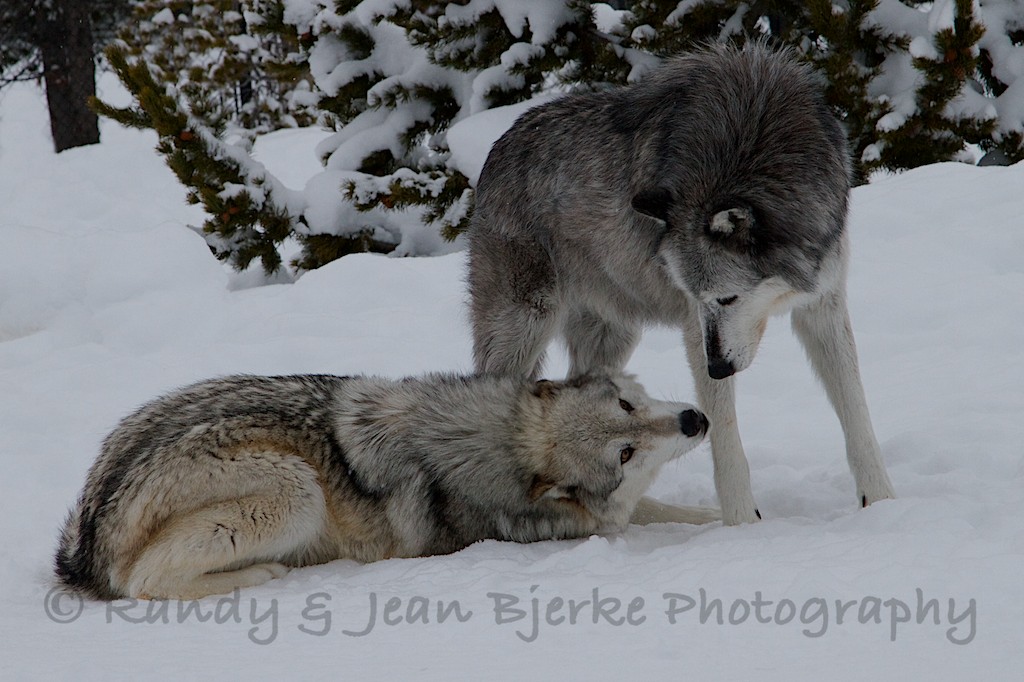
A special treat on our last visit to the Grizzly & Wolf Discovery Center in West Yellowstone was watching the alpha pair of their High Country Pack, McKinley and Adara, play and roughhouse. Adara, the light colored wolf in the next five shots, is the alpha female of her pack and is displaying characteristic submissive behavior to her mate, the alpha male.


McKinley & Adara - alpha pair of High Country Pack


McKinley (standing) & Adara


McKinley & Adara


McKinley & Adara


McKinley & Adara


The four wolves of the High Country Pack are McKinley and Leopold, brothers born in 2006, and Adara and Takoda, sister and brother born in 2009.


Adara & Takoda


Leopold (left) & Takoda

Adara & Takoda


The wolves are especially active around the time they are fed, and periodically in winter they get a carcass.


McKinley feeding


Adara with remains of a carcass


The Gray Wolf (canis lupus) can range in color from white to tan or grizzled gray, to black.  The Gray Wolf was once common throughout North America, but was hunted almost to extinction up to the 1930s. Then wolves were reintroduced to Yellowstone National Park in 1995. Their recovery in the northern Rockies is one of the great successes of the Endangered Species Act, yet they are also the subject of deep and vehement controversy.  


I will not comment here on the intense political controversy over wolves but will simply say that to me, wolves symbolize power and strength, wilderness and wildness. 


Leopold & Takoda


I am drawn to the beautiful Lamar Valley of Yellowstone to observe wild wolves, and there is nothing more awesome than watching these amazing animals in the wild. At the same time, the Grizzly & Wolf Discovery Center is one of my favorite places and a perfect place to observe wolves, as well as grizzlies.

Saturday, December 22, 2012

Trumpeter Swans on Henry's Fork

There is a special magic in observing the graceful Trumpeter Swan. This week we photographed these birds on the Henry's Fork of the Snake River, at Last Chance in Island Park, Idaho - part of the Greater Yellowstone Ecosystem.


It was about an hour before sunset when we arrived at Last Chance and set up our photography equipment. More than a hundred birds were visible on the river, with the late afternoon light catching the pure white of the mature adults beautifully. 


The birds seemed wary when we walked down towards the bank, and moved off in another direction, some swimming, and some taking flight. But if we walked along the road they seemed tolerant of our presence, no doubt having seen plenty of humans and cars in that location.


Periodically some of the birds would seem to stand up on the water, stretching and flapping their wings, or would take off, fly a short distance, and land with another group of birds.


As sunset approached, the swans became more active, with more birds flying up and down the river to land in different locations.


Yellowstone National Park reported this year that "Participants in the West Yellowstone Christmas Bird Count tallied 190 trumpeter swans on the Madison River and nearby open waters adjacent to Yellowstone National Park on December 16th. The Madison and Yellowstone rivers within the park also provide favorable wintering habitat for trumpeters, most of which nest in northern Canada." 


A few thousand swans are reported to winter throughout the Greater Yellowstone Ecosystem. Most of them are birds that nest and spend their summers in Canada. Read more about wintering Trumpeter Swans in Greater Yellowstone in my blog post of last January.


Tuesday, September 4, 2012

Bull Elk #10 in Yellowstone


This magnificent bull was resting not far from the road, in the late afternoon. We spotted him on September 2, 2012 near the road between Sheepeater Cliff and Mammoth in Yellowstone, and of course immediately noticed the yellow tag in his ear. He turned out to be the "famous" bull elk #10 that others have photographed and written about. 

Bull Elk #10 in Yellowstone ~ Jean Bjerke photo


As typically happens in Yellowstone, he had attracted an admiring small crowd, who wisely kept their distance. Park rules require humans to stay at least 25 yards from this massive animal.


Bull Elk #10 resting near Blacktail Ponds ~ Randy Bjerke


Curious whether we could find records of bull elk #10, we found mention of him in Beth Pratt's blog from September 2008, when her pictures showed him to be a beautiful 6x6-point bull. In February 2009 Kurt Repanshek wrote in his National Parks Traveler about the death of another well-known elk, bull elk #6, characterizing these two bulls as having been arch-rivals. In January 2011, artist and sculptor George Bumann photographed bull elk #10 near Blacktail Ponds, and by this time the bull had a beautiful, even seven-point rack of antlers. Bumann wrote "I sure hope that we will get to see him next autumn!"  In June 2012, the Guidebook of Yellowstone Wildlife reported that bull elk #10, "one of the most popular bulls in the park," was spotted near Blacktail Ponds. A google search turned up some beautiful images and several videos of this bull. What a privilege to see him ourselves!

Bull Elk #10 - Note perfect 7x7-point rack ~ Jean Bjerke


Bull Elk #10 ~ Jean Bjerke


Well, he is back! He looks good, well-fed, with his coat in good shape. A beautiful animal, he will no doubt again be one of the dominant males during the elk rut in Yellowstone. 


Bull Elk #10 ~ Jean Bjerke

Wondering how he came to be tagged? Al Nash, Public Affairs Officer in Yellowstone National Park, provided this explanation to Elizabeth Laden, editor of the Island Park News: "Several years ago, this particular elk managed to get a badminton net and poles wrapped around his antlers. He had to be darted and immobolized to remove the items. The FDA has concerns over potential impacts the chemical residue may have if humans consume the meat within a certain period of time. Tagging the animal serves as a flag to hunters to check on the history of the animal if harvested."


Bull Elk #10 ~ Randy Bjerke

Monday, April 23, 2012

Opening Day in Yellowstone


Four of the five entrances to Yellowstone National Park are closed to wheeled vehicles from November until April or May. The first to re-open in spring is the West Entrance in West Yellowstone. Our photographer friend Pam Talasco had been counting the days for months and had persuaded us that we absolutely had to be there for Opening Day. Numerous serious photographers and ordinary tourists shared the park this weekend.
The night before the park opened, we were excited with anticipation. Bears had been sighted with cubs around the park in recent weeks, and a wolf had been sighted in the geyser basin not long before. There were already many signs of spring, not the least of which was the weather forecast of temperatures in the 60s for the first two days the park would be open.
A line of cars formed at the entrance awaiting the exact hour of 8:00 when the entrance would open. There was surprisingly little snow along the entrance road due to the warm weather of recent weeks. Not much animal activity in the first couple of hours. Two Canada geese in the bald eagle nest looked incongruous. Imposters!


A few bison and some elk were spotted from a distance, and some bison owned the road, but mostly we just enjoyed the scenery on a leisurely drive down to Old Faithful, then back through the geyser basins, past Madison and north past Norris. Beautiful scenery as we passed Gibbon Falls and Gibbon Meadow.


Our next destination was north of Mammoth where a wolf pack had been seen recently along the Gardiner River. We sighted more bison at tiny Joffee Lake along the way.


American Bison

Beyond Mammoth, in the canyon of the Gardiner River, excitement built when we saw an elk carcass just across the river, not far from the road, a good distance for photos. Wolves are attracted to any animal carcass, or may even have killed the animal, and it was promising that a small group of photographers with big lenses had already gathered. 

One of the photographers told us wolves had been on the carcass that morning, harassed by a couple of coyotes, and had stayed there till 10:30 AM. Wolves often return to the carcass in such a situation, and we decided to stay to see if they would return. We waited four and a half hours until after the sun went down, with no sign of wolves, enjoying the conversation among photographers, as some brought out and shared parts of their portfolios in 8x10 prints in binders, or on an iPad, and we talked about various animal sightings.

Having seen only ravens and Canada Geese hanging out by the river, when a pronghorn strolled nonchalantly across the opposite hillside we figured if he had sensed wolves he certainly would not have been there.


Canada Goose

Grizzly ~ Photo by Randy
The thrill of this first day was a sighting of a grizzly bear on the way back to town. The grizzly was digging for grubs in a meadow near Obsidian Creek, with a few wispy plumes from thermal activity nearby. Numerous cars pulled over, and a few people got out of their cars, as the bear was at a safe distance. Then he decided he wanted to walk up the hill towards the road! Bear watchers scattered back into their vehicles as the animal crossed the road and started up the hill on the other side. What a thrill to be so close to him, but photography was disappointing in the dim light after sundown.
The next morning, this was the first place we went, and the bear treated us to a very nice view, as he crossed the road again, from the hillside where he was first spotted, down into the meadow.


The grizzly is a large predator that usually weighs 400-600 pounds, and can run 35 miles per hour. Once found throughout the plains and western mountains of North America, this species has been reduced to about 2% of its former habitat, and Yellowstone, where it is officially considered a “threatened” species, is important to its survival. Its coloration is usually dark brown, but can vary from a light cream color to black. In contrast to the black bear, it has a more concave face and a distinctive hump on its shoulders. The grizzly is omnivorous and will eat anything from grasses, berries, insects, or fish, to mammals including elk, moose and bison.
Grizzly ~ note the shallow concave face and distinctive hump


After watching the bear, we decided to drive back to Mammoth, east to the Lamar Valley, and then back to Canyon if we had time, which would complete our drive on all the roads open so far in the park. We proceeded across the beautiful Swan Lake Flats where there was still ice on the lake and ponds.

Swan Lake Flats


Climbing to the Blacktail Plateau we saw more bison than we had seen so far in the park, mostly grazing on distant hills. A massive animal, bison stand up to 6’6” at the shoulder and the male can weigh up to a ton. They can run at a speed of 30 miles per hour or more. They live up to 22 years in the wild and longer in captivity. Bison are now found mostly in a few national parks and private herds. They are a common sight in Yellowstone, where more than 3,000 live,  and they are one of the special memories of most visitors.
Bison on Blacktail Plateau


A group of bighorn sheep grazed hear the road. The Rocky Mountain bighorn sheep is extraordinarily sure-footed in navigating high cliffs and rocky mountain terrain, and able to survive the harshest Rocky Mountain winters. A striking animal with its huge curved horns, bighorns eat grasses in summer and more woody plants in winter.
Rocky Mountain Bighorn Sheep
Buttercups were beginning to bloom, and attracting butterflies.
Buttercups


There was no snow on the ground in beautiful Lamar Valley.
Lamar Valley
Just as Randy remarked we had seen fewer birds than he expected, we came upon this sandhill crane standing in the road! The sandhill cranes of Yellowstone migrate here for summer from wintering grounds in the Rio Grande Valley
Sandhill Crane

Pulling over, we watched the bird join two other cranes, below us down an embankment, then strike off from the other two, foraging among the sage and brush.
Photo by Randy

Photo by Randy


Driving back to Canyon, our second day in the park concluded with a view of Lower Yellowstone Falls, where the snow bank was breaking up and crumbling into the river and the roar of the waterfall filled the canyon.


Lower Yellowstone Falls from Inspiration Point


Our two days in Yellowstone for Opening Day marked the beginning of National Park Week, celebrated nationally in our nation’s 397 parks. What a privilege to spend these two days in magnificent Yellowstone, established as the nation’s first national park in 1872.


Sunday, January 8, 2012

Wintering Trumpeter Swans in Greater Yellowstone Ecosystem

Trumpeter swan in summer on Madison River in Yellowstone


The majestic, elegant, pure white Trumpeter Swan (Cygnus buccinator) can be seen year-round in Yellowstone Park, often swimming in the Madison River. It is also a “species of concern” here, and the National Park Service considers it the most imperiled bird in Yellowstone. It is thought that last season, Yellowstone’s year-round population had declined to less than ten birds, though a few thousand additional swans winter in the general area.


By the time they are a year old, swans acquire their pure white plumage


Many more swans winter in the Greater Yellowstone Ecosystem, than spend the summer here, and except for the first image above, the remainder of the images in this blog post were made in winter. 


The trumpeter swan is known to be sensitive to human activity, and to abandon nesting and wintering areas if there is nearby human development. Nevertheless, this year, a sizable number of swans have been wintering at Last Chance, in our adopted home town of Island Park, Idaho. To our great joy, a small number of swans are also attracted to a small spring-fed pond near our cabin, just below Raynolds Pass and the Montana border. This is where we photographed these birds. 
Four adult trumpeter swans


Apparently the group of swans on the nearby pond is able to tolerate a few snowmobiles, and a few people on foot or skis, going by each day. There is no other motorized traffic in winter. The pond is half a mile from the highway and a mile and a half from the nearest year-round residence. These birds allowed us to stand at the edge of the pond to photograph them, and seemed to pay no attention to our telephoto lenses.


Trumpeter swans have very long necks

The trumpeter swan is a very large pure white bird, with a long graceful neck, and black bill and face. It weighs 20-30 pounds and measures up to four feet in length. It is the largest North American waterfowl, and in flight, its impressive wingspan extends eight feet. Immature birds, called cygnets, are a sooty grey color until their first spring. 


The adult swan is pure white, the cygnet a sooty grey


Because their diet is primarily aquatic vegetation - a mature adult can eat 20 pounds in a day (U.S. Fish & Wildlife Service) - trumpeter swans need access year-round to open water where that vegetation grows. In shallow water they tip up to reach submerged vegetation, shaking water droplets off their face and neck as they raise their head.


Swans tip up to feed on submerged vegetation


Raising its head after feeding, the swan shakes water droplets from its head


Dabbling ducks such as mallards and ducks that dive, such as the common goldeneye, which have similar feeding habits to the trumpeter swans, may be found along with the swans where feeding conditions encourage it.
This male common goldeneye was feeding with the swans


In addition to development and habitat destruction over the years, the Trumpeter Swan was hunted to the brink of extinction by the early 1900s, favored for its gorgeous white plumes. The species has recovered to about 20,000 in North America (NPS), of which about 500 live in the Greater Yellowstone Ecosystem, but less then ten individuals live permanently in the park itself (NPS) - down from 27 reported for the year 2000. Another 4,000 Trumpeter Swans from Canada also winter in the same area. (USFWS) Red Rock Lakes National Wildlife Refuge in the nearby Centennial Mountains, provided key breeding habitat for the recovery of the swans.


A few days after photographing the birds pictured above, on an early January winter snow coach trip into Yellowstone Park, we observed group of five swans on the Firehole River in Yellowstone, enveloped in the fog and mist of early morning.


Trumpeter Swans in winter on Firehole River in Yellowstone